Centripetal and Centrifugal: Understanding the Forces That Shape Motion
In the fascinating world of physics, centripetal and centrifugal forces play a crucial role in understanding motion and its dynamics. These forces are not just theoretical concepts but are actively present in our daily lives, influencing everything from amusement park rides to the motion of planets in space. Whether you're an aspiring physicist, a curious student, or simply someone eager to learn more about the forces that govern motion, this article will provide you with comprehensive insights into centripetal and centrifugal forces.
Our exploration begins with a fundamental question: What exactly are centripetal and centrifugal forces? In simple terms, centripetal force is the inward force that keeps objects moving in a circular path, while centrifugal force is the apparent outward force experienced by objects in rotation. Understanding these forces is essential for grasping the mechanics of circular motion, which is a cornerstone of classical mechanics.
Throughout this article, we'll delve into the scientific principles behind centripetal and centrifugal forces, explore real-world applications, and uncover the mathematical relationships that govern their behavior. By the end, you'll have a solid understanding of how these forces shape the world around us. So, let's embark on this exciting journey of discovery!
Introduction to Centripetal and Centrifugal Forces
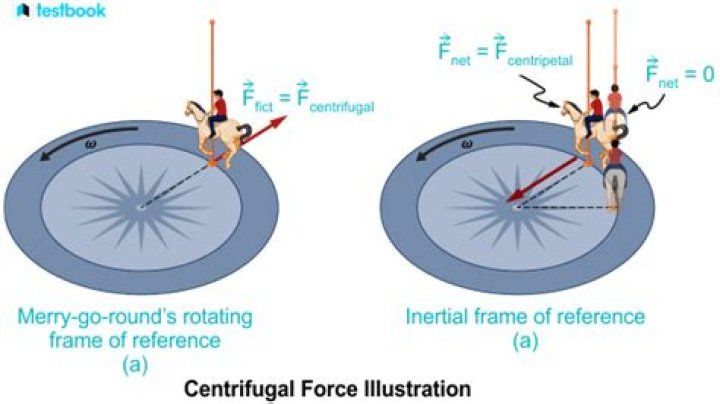
Centripetal and centrifugal forces are fundamental concepts in classical mechanics. These forces are intricately linked to the motion of objects moving in circular paths. Centripetal force is defined as the inward force that acts toward the center of a circular path, ensuring that an object follows a curved trajectory rather than moving in a straight line. On the other hand, centrifugal force is the apparent force that seems to push objects away from the center of rotation when observed from a rotating reference frame.
Why Are These Forces Important?
These forces are important because they govern the behavior of objects in rotational motion. Without centripetal force, planets would not orbit stars, and vehicles would skid off curved roads. Similarly, centrifugal force helps explain phenomena like the feeling of being pushed outward when riding in a car that takes a sharp turn. Understanding these forces allows engineers, physicists, and even everyday people to make sense of the world around them.
Scientific Principles Behind Circular Motion
Circular motion is governed by Newton's laws of motion. When an object moves in a circle, its velocity is constantly changing direction, even if its speed remains constant. This change in velocity requires a net force acting toward the center of the circle, which is the centripetal force. According to Newton's second law, \( F = ma \), the magnitude of the centripetal force can be calculated using the formula:
\( F_c = \frac{mv^2}{r} \), where \( F_c \) is the centripetal force, \( m \) is the mass of the object, \( v \) is its velocity, and \( r \) is the radius of the circular path.
Centripetal Acceleration
Centripetal acceleration is the acceleration directed toward the center of a circular path. It is given by the formula \( a_c = \frac{v^2}{r} \). This acceleration is always perpendicular to the object's velocity, ensuring that the object follows a curved path.
Mathematical Explanation of Centripetal Force
The mathematical relationship between centripetal force, mass, velocity, and radius is crucial for understanding its behavior. As mentioned earlier, the formula for centripetal force is:
\( F_c = \frac{mv^2}{r} \).
This equation reveals that centripetal force increases with the square of the velocity and decreases with the radius of the circular path. For example, if the velocity of an object doubles, the required centripetal force increases fourfold, assuming the radius remains constant.
Factors Affecting Centripetal Force
- Mass: Greater mass requires greater centripetal force to maintain circular motion.
- Velocity: Higher velocities demand stronger centripetal forces.
- Radius: Larger radii reduce the required centripetal force.
Centrifugal Force: The Concept Explained
Centrifugal force is often misunderstood as a real force, but it is actually a fictitious force that arises in rotating reference frames. In an inertial reference frame, there is no such thing as centrifugal force. However, when observed from a rotating frame, objects appear to be pushed outward due to inertia. This apparent force is called centrifugal force.
Applications of Centrifugal Force
Despite being a fictitious force, centrifugal force has practical applications in various fields:
- Amusement Park Rides: The sensation of being pushed outward in rides like centrifuges is due to centrifugal force.
- Centrifuges in Laboratories: These devices use centrifugal force to separate substances based on density.
- Space Stations: Artificial gravity in space stations is created using centrifugal force.
Real-World Applications of Centripetal and Centrifugal Forces
Centripetal and centrifugal forces are not just theoretical concepts; they have numerous real-world applications:
- Automobiles: Tires generate centripetal force to keep vehicles on curved roads.
- Astronomy: Centripetal force keeps planets in orbit around stars.
- Engineering: Rotating machinery relies on centripetal force to function properly.
Examples of Centripetal Force in Daily Life
In daily life, you encounter centripetal force in situations such as:
- Swinging a ball tied to a string in a circular motion.
- Riding a bicycle around a bend.
- Water remaining in a bucket when swung in a vertical circle.
Comparison of Centripetal and Centrifugal Forces
While centripetal and centrifugal forces are related, they differ significantly:
- Centripetal Force: A real force directed toward the center of a circular path.
- Centrifugal Force: A fictitious force observed in rotating reference frames, directed outward.
This distinction is crucial for accurately analyzing circular motion.
Key Differences
The key differences between these forces include their nature (real vs. fictitious), direction (inward vs. outward), and the reference frames in which they are observed.
Common Misconceptions About These Forces
Many misconceptions surround centripetal and centrifugal forces. For instance, some people believe that centrifugal force is a real force acting on objects. In reality, it is merely an apparent force caused by inertia in rotating frames. Additionally, some confuse centripetal force with gravitational force, although they are distinct concepts.
Addressing Misconceptions
Clearing up these misconceptions is vital for developing a proper understanding of circular motion. Educators and scientists play a crucial role in dispelling myths and promoting accurate knowledge.
Experiments and Demonstrations Involving These Forces
Hands-on experiments and demonstrations can help illustrate the concepts of centripetal and centrifugal forces:
- String and Ball Experiment: Tie a ball to a string and swing it in a circle to observe centripetal force in action.
- Centrifuge Demonstration: Use a simple centrifuge to separate substances based on density.
- Car and Turn Experiment: Observe the effects of centripetal force when a car takes a sharp turn.
Importance of Practical Demonstrations
Practical demonstrations enhance understanding by allowing individuals to experience these forces firsthand. They also make learning more engaging and memorable.
Historical Perspective and Contributions to Physics
The study of centripetal and centrifugal forces has a rich history. Isaac Newton's work laid the foundation for understanding these forces. Later, scientists like Daniel Bernoulli and Leonhard Euler contributed to the development of theories related to circular motion.
Modern Contributions
Today, researchers continue to explore these forces in various contexts, including space exploration, engineering, and technology. Their work builds upon the foundational principles established by earlier scientists.
Future Research Directions in Circular Motion
As technology advances, new opportunities for studying centripetal and centrifugal forces arise. Areas of interest include:
- Space Exploration: Investigating artificial gravity in space habitats.
- Engineering Innovations: Developing more efficient machinery based on circular motion principles.
- Biomechanics: Studying the effects of these forces on human physiology.
Potential Breakthroughs
Breakthroughs in these areas could revolutionize industries and improve our understanding of the universe.
Kesimpulan
Centripetal and centrifugal forces are integral to the study of circular motion and have far-reaching implications in science, engineering, and everyday life. By understanding their principles, applications, and distinctions, we gain valuable insights into the mechanics of motion. As we continue to explore these forces, new discoveries will undoubtedly emerge, further enriching our knowledge of the physical world.
We invite you to share your thoughts and questions in the comments section below. Additionally, feel free to explore other articles on our site for more fascinating insights into the world of physics and beyond. Together, let's continue learning and growing!
Sources:
- Physics for Scientists and Engineers by Raymond A. Serway and John W. Jewett
- Fundamentals of Physics by David Halliday, Robert Resnick, and Jearl Walker
- Classical Mechanics by Herbert Goldstein